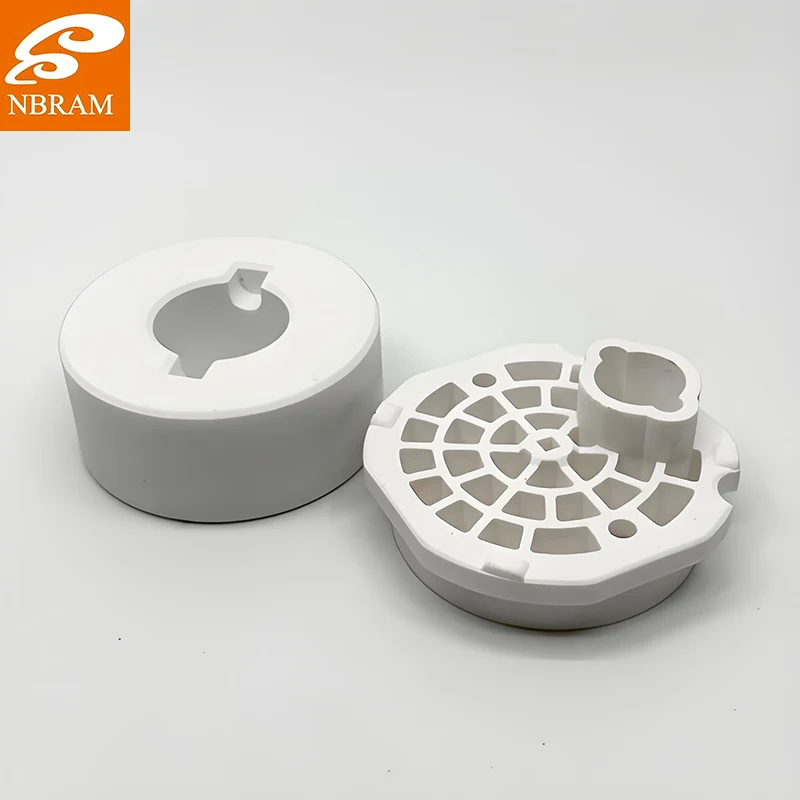

A thermocouple bead looks like the least interesting part of a temperature sensor. It is a short alumina tube with a hole through it, slid over the wires between the hot junction and the terminal head. Nothing moves, nothing glows, nobody photographs it. Yet a good share of the drift complaints we hear about start right there, in a bore that was a few hundredths of a millimetre off or a bead that picked up moisture on the shelf.
We press and sinter these beads ourselves, so tolerance arguments happen on our own floor, not across a purchase order.
A customer usually specifies the outside diameter, because that is what has to fit inside a protection tube or a drilled block. Our standard range runs from 2 mm to 12 mm OD, with bores from 0.5 mm to 6.0 mm to cover the common thermocouple wire gauges.
The number that actually decides whether the assembly works is the bore. We hold bore consistency to ±0.02 mm. Too tight, and the wire will not feed through without forcing, which nicks the insulation and puts a stress point right where the thermal gradient is steepest. Too loose, and the bead rattles on the wire, so the string shifts during installation and the junction ends up sitting deeper or shallower than the drawing says. That changes response time more than most people expect.
Bore size is set at extrusion, which is why we spend the setup time there instead of sorting finished parts later. Every bead is formed from high purity alumina powder, 99.5% Al2O3, taken through several purification stages to pull out trace elements that would otherwise give the ceramic a leakage path once it is hot.
Insulation resistance is the reason the bead exists, so it is the first thing we test. Dielectric strength is above 15 kV/mm at room temperature and still holds 8 kV/mm at 1000°C. Those two numbers are not interchangeable, and a supplier who quotes only the room temperature figure is telling you half the story.
Each production batch goes through dielectric testing at 1000 V AC before it is packed. Not a sample of the batch. The test is quick, and it catches the failure mode that matters most in service: a hairline crack or an oversized pore that only shows up under voltage. A bead that passes a visual check can still fail here, which is why we keep the step.
Porosity is controlled for a second reason. Open pores absorb moisture, and moisture inside an alumina bead turns to steam on the first ramp to working temperature. That is the classic path to a cracked bead and a grounded thermocouple in a furnace that has just been commissioned.
Thermal shock resistance allows temperature changes of 800°C per minute without cracking. In a laboratory that reads like a generous margin. In a real furnace it is the difference between a bead that survives a door opening during a full load and one that spalls.
Compression strength sits at 250 MPa, which covers the clamping force of a typical mounting block and the occasional over-tightened fitting. Firing happens in computer-controlled kilns on managed temperature profiles, since a profile that runs too fast leaves residual stress in the ceramic that no downstream inspection will find. Batches are then thermal cycled to simulate service in aggressive environments.

Final inspection is optical: surface finish under a microscope and dimensions against an optical comparator. Anyone who has chased an intermittent reading knows how small a chip at the bore edge has to be before it starts cutting into wire insulation.
Where do these beads end up? Glass furnaces running above 1600°C, chemical process lines where the atmosphere attacks anything less stable, and power generation equipment where a wrong reading is a safety item rather than an inconvenience. The bead is cheap next to the thermocouple and trivial next to the furnace. It still has to be right.
If you are specifying thermocouple protection for a new assembly, send the wire gauge and the bore you need and we will match it against stock tooling. Details are on our Thermocouple Ceramic Insulation Bead page, and the wider range of pressed and machined parts sits under Heating and Insulation Ceramics. For furnace builds, the High-Temperature Furnace Ceramic Chamber runs on the same alumina line.