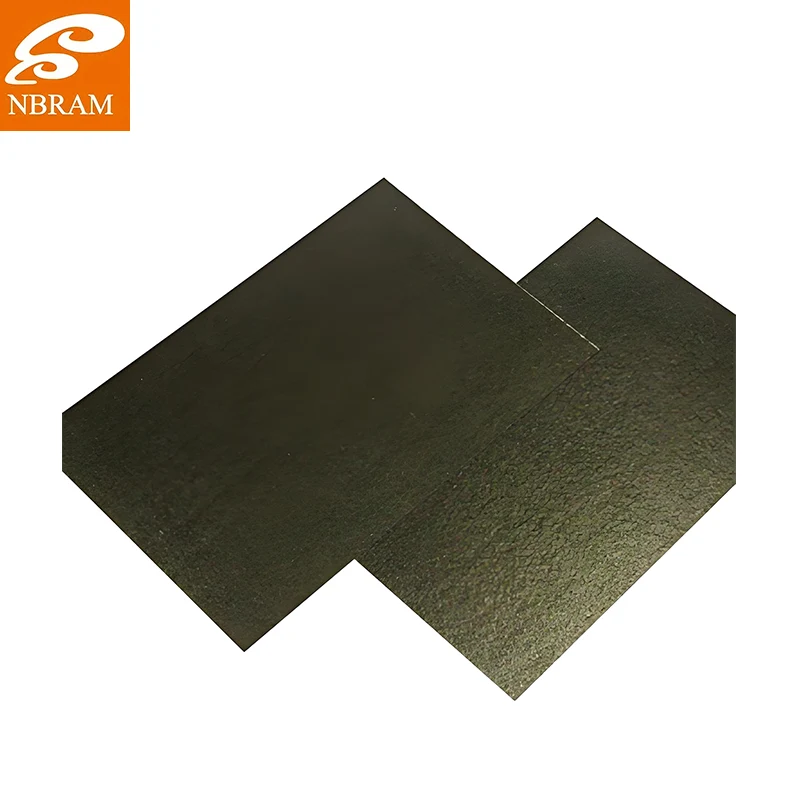
When your project requires absolutely pure insulation materials, NBRAM synthetic mica plate provide an irreplaceable solution. This lab-grown material contains zero metal impurities, maintaining stable electrical performance even at 1200°C high-temperature environments, making it particularly suitable for semiconductor manufacturing, photovoltaic cell production, and medical equipment insulation. Compared to natural mica, its dielectric strength improves by over 50% with completely consistent physical properties. Customer feedback shows our synthetic mica plates last 60% longer than natural products in wafer processing equipment heaters. When procuring highest-standard mica plates, we recommend choosing suppliers like NBRAM with complete quality certification systems.
In the latest photovoltaic cell sintering furnace project, NBRAM synthetic mica plate set a record of 18 months continuous operation without replacement—thanks to its completely consistent chemical composition and crystal structure. Its unique value lies in zero-porosity dense structure, completely blocking process gas penetration and preventing circuit shorting. A semiconductor equipment manufacturer uses it as core insulation material for wafer heaters, maintaining volume resistivity above 10¹³Ω•cm at 1200°C operating temperature. More notably, this material complies with USP Class VI certification, making it the preferred choice in medical sterilization equipment where traditional materials would leach impurities contaminating medical environments.
We start with high-purity chemical ingredients including potassium fluorosilicate and magnesium oxide, ensuring final product metal impurity content below 50ppm. Through unique melt crystallization process, we grow perfect defect-free mica single crystals at 1400°C—this specification exceeds industry standards by two orders of magnitude. In forming technology, we use isostatic pressing to create isotropic dense structures—key to product uniformity.
The sintering process occurs in 1650°C vacuum environment, ensuring complete densification. Our engineers determined this temperature range achieves perfect crystal orientation through extensive experimentation. The final precision machining stage proves crucial—employing diamond tools for nanometer-level precision cutting, ensuring surface flatness reaches Ra0.1μm mirror finish.
Beyond routine performance tests, we use electron microscopy to examine crystal structure integrity. Each batch undergoes 30 thermal cycles (room temperature to 1200°C) ensuring extreme condition reliability. Notably, we provide specialized trace element analysis reports for semiconductor clients—data critical for chip manufacturing processes.
Taking NBRAM synthetic mica plate : density stabilizes at 2.82g/cm³, available in ultra-thin specifications from 0.1mm to 3mm with remarkable thickness tolerance within ±0.005mm. During high-temperature testing, dielectric strength remains above 25kV/mm at 1200°C, with volume resistivity stable at 10¹³Ω•cm. The thermal expansion coefficient of 6.8×10⁻⁶/℃ closely matches silicon wafers, benefiting thermal matching in semiconductor manufacturing. Standard sizes include 300×300mm, 400×600mm, with laser precision machining available. Bend strength maintains over 120MPa at 1100°C.