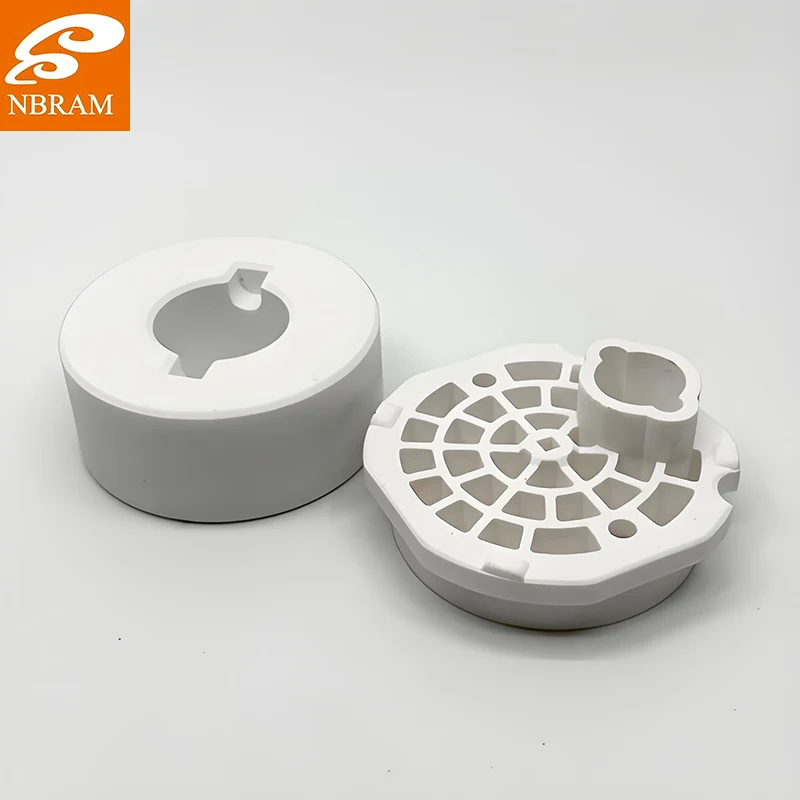

A drawing lands in our inbox with a shape that looks easy: a flat plate, two holes, one notch. The note says "insulating, high temperature" and stops there. Most of the time that part comes back for revision — not because the shape is hard to cut, but because three numbers are missing from the sheet.
Custom mica insulators are cheap to change on paper and painful to change after the first batch. Here is what we ask for before a quotation leaves the desk, and what each number actually does on the shop floor.
Our working range runs from 0.1mm sheet up to 50mm block. A 0.1mm part is usually a barrier slipped between a heating element and a metal housing, where the gap is fixed and the designer has no room left. A 25mm or 50mm block is doing a different job: holding a hot component away from a frame, or taking compression without cracking.
Thickness also sets how much voltage the part can stand. The figure we work to is up to 25kV per millimetre, so a 0.4mm insulator and a 2mm insulator are not interchangeable in a 10kV slot, even when both are cut from the same mica grade. Send the working voltage and the thickness follows from there.

We cut to within 0.1mm of your drawing. That number covers the outline. It does not automatically cover hole position, notch depth, or how square the edge sits against a mating face. If a hole locates the part on a threaded stud, give it its own tolerance. If a notch only clears a weld seam, a looser callout saves money and nobody notices.
The same logic applies to flatness. A 0.5mm plate that has to sit flush against a heater body needs a flatness note. A 0.5mm plate hanging in free air usually does not.
Mica is a laminated material: layers of mica paper bonded with resin or silicone. A laser cuts it quickly, but heat chars the binder at the cut line and can loosen the laminate right where you need the edge to stay tight. We cut these parts on a waterjet instead. The jet removes material with no heat-affected zone, so there is no burnt rim to sand back and no softened edge to argue about at inspection.
That choice costs a little cycle time. It saves the discussion that follows when a part fails at the edge rather than in the middle.
Mounting holes, clearance notches, a slot for a retaining clip, a step so the part sits under a bracket: all of these belong on the first drawing. Adding a hole after the first batch means a new program on a machined part and, on a stamped part, possibly new tooling. Cost barely moves at the quoting stage. It moves a lot at the rework stage.
If you are still choosing between routes, the two behave differently. CNC machined mica components suit low volume and awkward geometry, where the shape is still moving. Stamped mica parts pay off once the outline is stable and the quantity is steady.
We have been cutting these parts for about fifteen years, and the sequence has not changed much. Drawings get reviewed, questions come back before anything is cut, then samples go out for a fit test on your bench. Volume runs only after the sample passes. Every piece is tested before it is packed, not just the first one off the line.
If the sample needs a tweak, that is normal. Better a second sample than a second batch.
Send the drawing, the working voltage and the temperature at the interface, and we will come back with a thickness and tolerance you can put straight into the BOM. Start from the custom shape mica insulator page, or look through the wider mica insulation assemblies range if the part has to carry metal inserts or brackets.