
A salon owner sends back a dryer that still runs. The coils are intact, the fuse is fine, but the mica board under the wire has browned and curled at one end. Most of the time the wattage on the label was never the problem. The problem was how fast that wattage was pushed through a given length of wire.
Hair dryer heating elements live on a number few spec sheets print: surface load, in W/cm². Get it wrong and a 2000W dryer can outlive a 1200W one, or fail inside a year. Here is how we read that sheet before quoting a build.
Our hair dryer heating elements cover 110V to 240V AC and 800W to 2200W. Two units at the same wattage can carry very different wire temperatures, because wattage says nothing about the area the wire has to spread it across. Surface load is watts divided by that wire surface.
We hold production elements at 4 to 6 W/cm². Some competing designs run 8 to 10 W/cm² for the same output, which means shorter, hotter wire and less air contact per centimetre. That shows up as faster heat-up and a shorter working life. If your airflow is already fixed by the fan and housing, load is the only lever left.

The specification section usually lists one temperature. Ask for the rest. Element wire reaches 550°C in our range, and we recommend running 350 to 450°C for hair safety and element life. Behind that wire sit two other ratings: ceramic supports at 1000°C, insulation at 750°C.
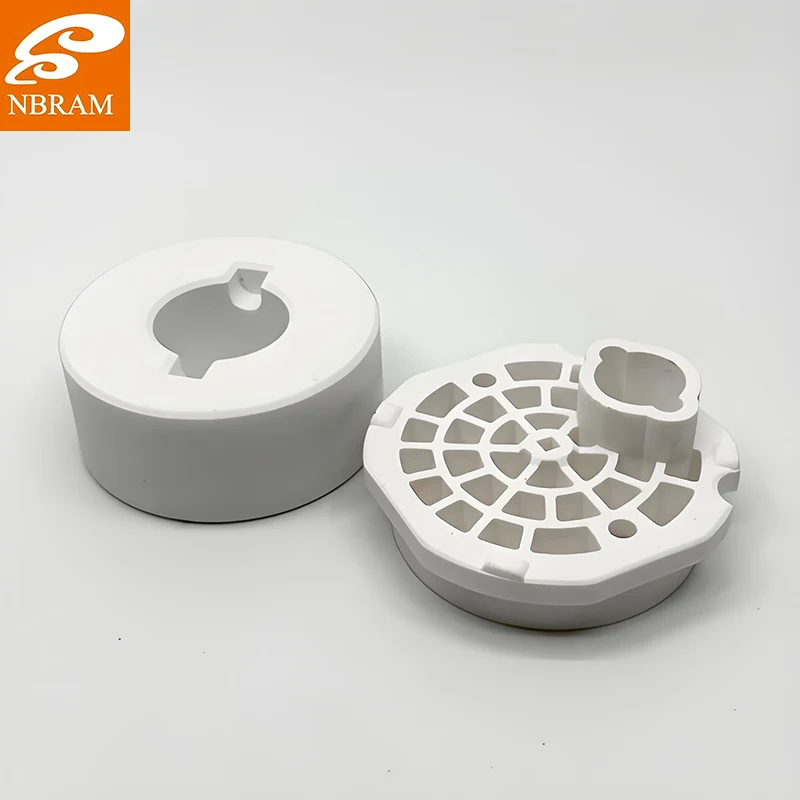
Those numbers are not interchangeable. A support rated well above wire temperature keeps the coil from sagging into the housing when thermal expansion pushes it sideways, which is why our supports use a grooved profile. The insulation rating answers a different question: air passing the element goes straight to someone's head, so the materials are formaldehyde-free and rated 750°C.
When a buyer asks for 600°C wire temperature "for margin", we usually ask about airflow first. More wire area lowers wire temperature for free, and it costs less than stepping up to a higher-grade alloy.
Batch-to-batch resistance is matched to ±3% on our line, and winding tension is held within ±2% by computer control. Together those two tolerances decide whether dryer number 1 and dryer number 4000 dry hair in the same time.
Resistance drift also shifts cutout timing. A dryer protected by a bimetal thermostat or a thermal fuse is calibrated against expected current, and 3% off sits inside that window. Ten percent does not. That is why we ask for the protection device and its trip point before finalising wire gauge.
Two more items belong on the drawing. Termination method comes first: fan motors vibrate, and a crimped joint loosens where a laser-welded one holds. Second, an open-coil layout lets air pass through the coil rather than only across its face, which flattens the hot spot at the centre of the duct.
Every element leaves our workshop after infrared thermal imaging, not just an electrical pass. Batches that meter correctly but image unevenly get rejected. On the customer side that has meant fewer "this one runs hotter than the other one" complaints, which are expensive to answer under warranty.
Send us your voltage, target wattage, airflow and housing envelope, and we will come back with a load figure and a wire gauge. Start from the hair dryer heating element page, or browse the wider mica heater range when the same element has to survive a harsher duct. Custom builds and samples are handled from the heating element section.