
A thermostat that opens eight degrees late does nothing useful. By the time it trips, the plastic around the element has already softened and the next event is a warranty claim rather than a spare part. Most of the work that prevents that happens on a line in Ningbo, before a KSD 9700 Series thermostat is ever powered up.
We build these bimetal thermostats for 0°C to 250°C duty with ±2°C accuracy, and they end up in electric water heaters, power tools, HVAC units, kitchen appliances and industrial motors. The housing is not the interesting part. The small domed disc inside it is.
Two metals with different expansion rates are bonded into one strip and stamped into a dome. As the thermostat warms, the high-expansion side grows faster and pushes the dome past its stable point. It flips, the contacts separate, and the circuit opens in a fraction of a second. That snap is the whole principle. A disc that creeps open instead spends longer in the arc while the contacts are still nearly touching, and it erodes the material it needs to conduct through.
Because the trip point lives in the disc geometry, curvature has to repeat from piece to piece. Flat spots are not cosmetic. They delay the flip, and a delayed flip at 16A/250V AC is where contact welding begins. Response time is under five seconds in most cases, and that figure matters more than it looks when the fault behind the overheat is a blocked fan.
A tolerance is not a number you print on a label, it is a number you test for. Every KSD 9700 unit is checked at multiple temperature points during calibration, and the small mechanical adjustments made at that bench decide whether the unit lands inside ±2°C or outside it. Custom orders have been pushed tighter than the catalogue figure, though the standard rating is what most appliance platforms are designed around.
Automatic reset is the other half of the behaviour. When the disc cools, it flips back and the appliance runs again without a service call. Convenient, yes. It also means the same disc will do the same work next week and the week after, so the geometry has to survive the movement and not just the temperature.
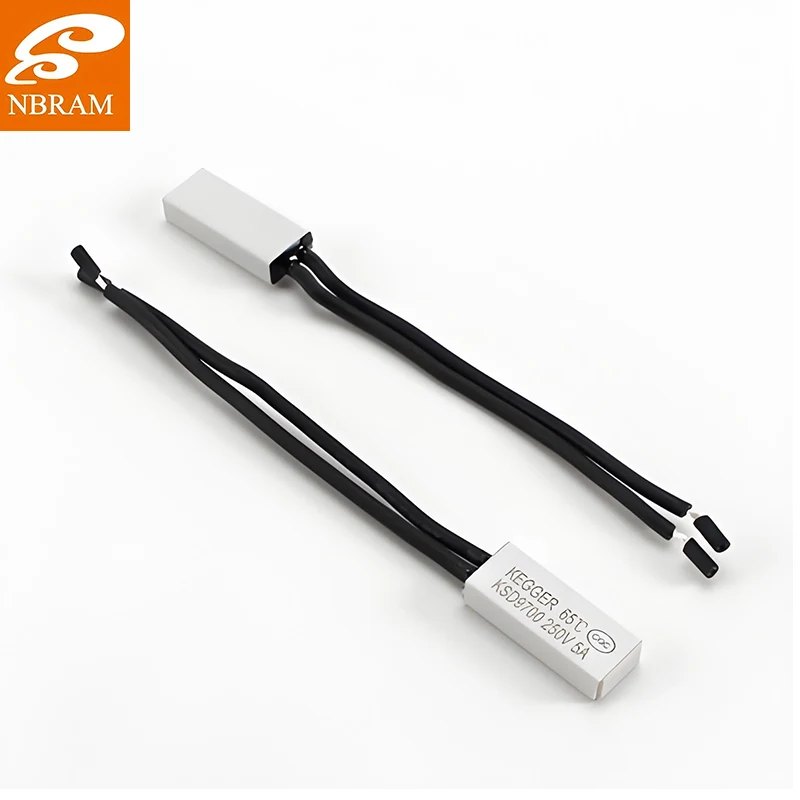
Moisture kills thermostats faster than heat does. Condensation on the contact faces changes resistance, and contaminated contacts switch erratically long before the disc wears out. Ours are closed by a welding process that keeps the disc sensitivity intact, and each seal goes through helium mass spectrometry afterwards. A leak no bubble test would ever catch is exactly the kind that returns as an intermittent field fault two years later.
The contacts are silver-cadmium oxide, chosen because they absorb the arc energy of a 16A resistive load without welding shut. Contact resistance holds below 50mΩ, contact pressure is set to keep a solid connection without chewing the surface, and insulation resistance stays above 100MΩ at 500V DC. Those three figures together decide whether the part behaves like a switch or like a resistor that runs warm.
Every unit is aged through thermal cycles before packing, a blunt way of removing the ones that would have failed first in someone's kitchen. Electrical testing then covers insulation resistance and dielectric strength, and the mechanical life rating of more than 100,000 cycles covers switches that cycle several times a day.
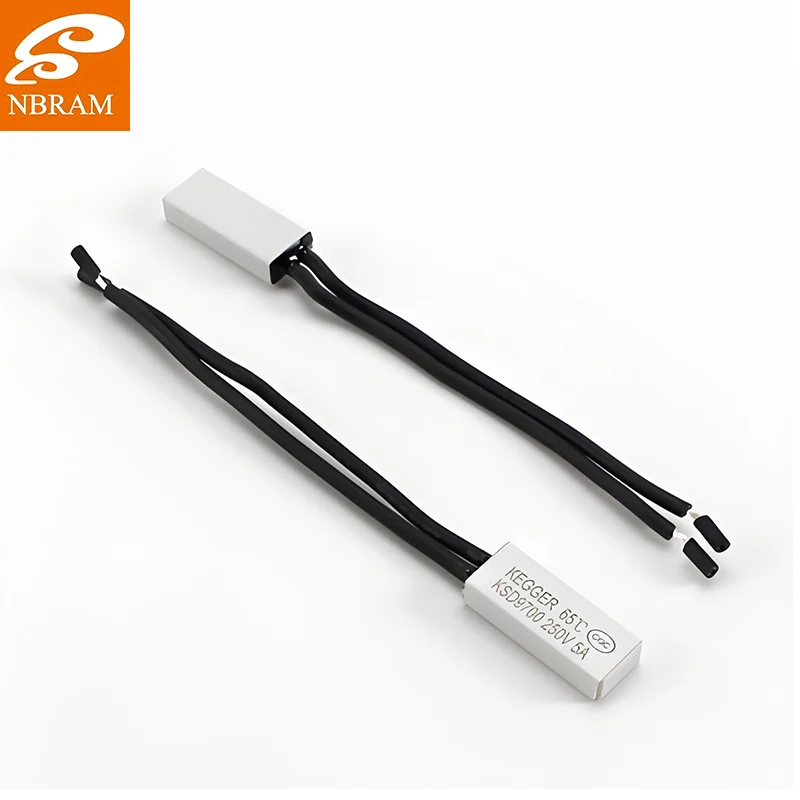
If you are specifying a thermal protector for a new appliance, or replacing one that trips late, the trip point is only the first question. Send us the load, the duty cycle and the working temperature window, and we will confirm which reset behaviour and sealing class fit before a sample is built. Specifications sit on the KSD 9700 Series page, and the wider range of bimetal thermostats sits under temperature controllers. Samples and OEM production runs are both available.