
Drop a straight tubular heater into a narrow appliance channel and it does exactly what physics says it should. The middle of the workpiece gets hot, the two ends stay cool, and someone on the line spends a month chasing a temperature spread that more wattage will not close.
An M-shaped heating tube attacks that spread with geometry instead of power. We fold the heated length into an M profile so the element wraps the part it is meant to heat, and the dead ends of a straight run disappear into the fold.
A straight tube radiates along one line. Fold it twice and the same sheath faces the workpiece from three directions at once, so the surface is surrounded rather than touched from a single side. In a cramped assembly that beats adding a second element: our standard tubes run 200 mm to 1200 mm, and the M layout delivers an effective heating length roughly 40 to 60 percent longer than the footprint the tube actually occupies.

There is a mechanical payoff too. The three contact points of the fold stop the tube from rocking inside its bracket. In equipment that vibrates, a tube that shifts is a tube with a short service life, and we have watched a loose straight element fail long before its sheath ever reached rated temperature.
Three numbers decide whether a folded heater survives its first month on the job: watt density, sheath temperature and alloy. Our M-shaped tubes run from 5 W/cm² to 40 W/cm² depending on the application, on sheath temperatures that can climb to 900°C in the hottest configurations.
Alloy is not a detail. Incoloy 800, 825 and 840 carry that heat with different corrosion resistance, and the choice should follow the atmosphere the tube works in, not the price list. Voltages stay just as wide, from 12V DC for low-voltage equipment up to 480V AC for industrial ovens, which is why the same bent profile turns up in everything from fluid cartridges to process tanks.
One habit we recommend on every order: run the tube at about 80 percent of its maximum rating. A heater pushed into the last 20 percent of its thermal headroom is a heater you will be replacing.
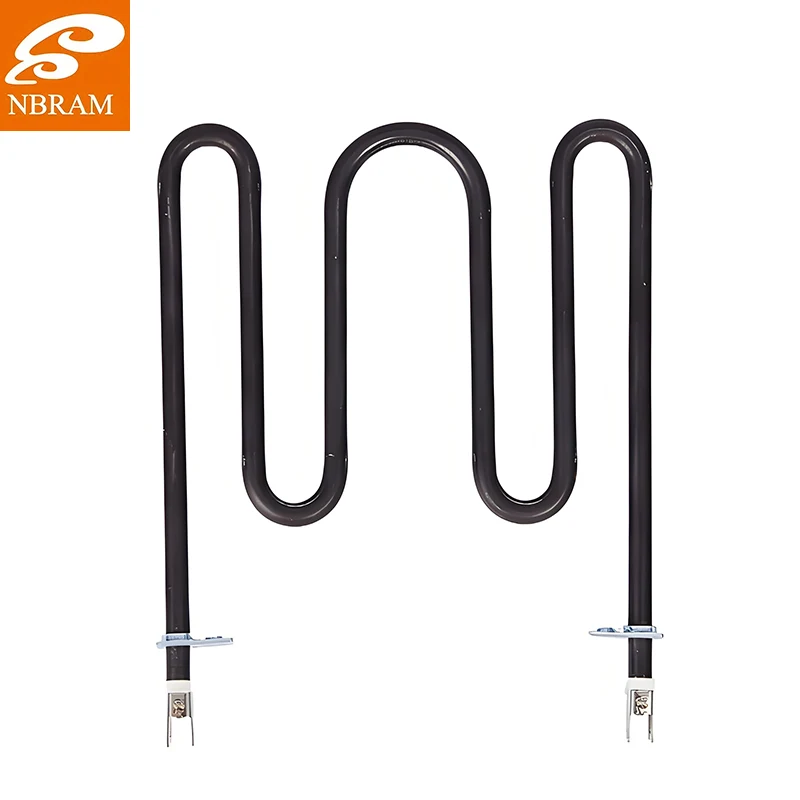
A bend that thins the wall is a failure waiting to happen. We form the tube over a mandrel, so the alloy flows around each curve and the wall keeps its thickness through every turn of the M.
Forming still leaves stress behind, so every tube gets a post-forming heat treatment: a controlled ramp to a set temperature, then a slow monitored cool. Skipping that step is cheaper up front, and it shows up later as a crack at the fold, usually within the first few thermal cycles.
Flying leads, screw terminals and quick-connect fittings cover most installations, and matching the termination to the assembly saves wiring time at the line. Tell us the space you have, the temperature you need and the medium being heated, and we will fold the profile to suit the part instead of asking you to redesign the part around a straight tube.
Samples of the M-shaped heating tube are available for bench testing, and custom lengths, watt densities and terminations are part of our normal production. See the full specification on the M-shaped Heating Tube page, or browse tubular and cartridge heaters for the wider range.