
Transformers, oven elements, battery packs: anything that cycles hot and cold pulls its insulation in two directions at once. Rigid mica laminates handle the heat but not the movement. Edges crack, and delamination starts at a cut corner. That is the failure we set out to remove with our silicone bonded flexible mica plate, which holds its dielectric strength from -60°C to 600°C and still bends without splitting.
People assume the hard part is the mica. It isn't. The hard part is the bond between mica and silicone surviving thousands of thermal cycles, and that comes down to process discipline more than to raw material.
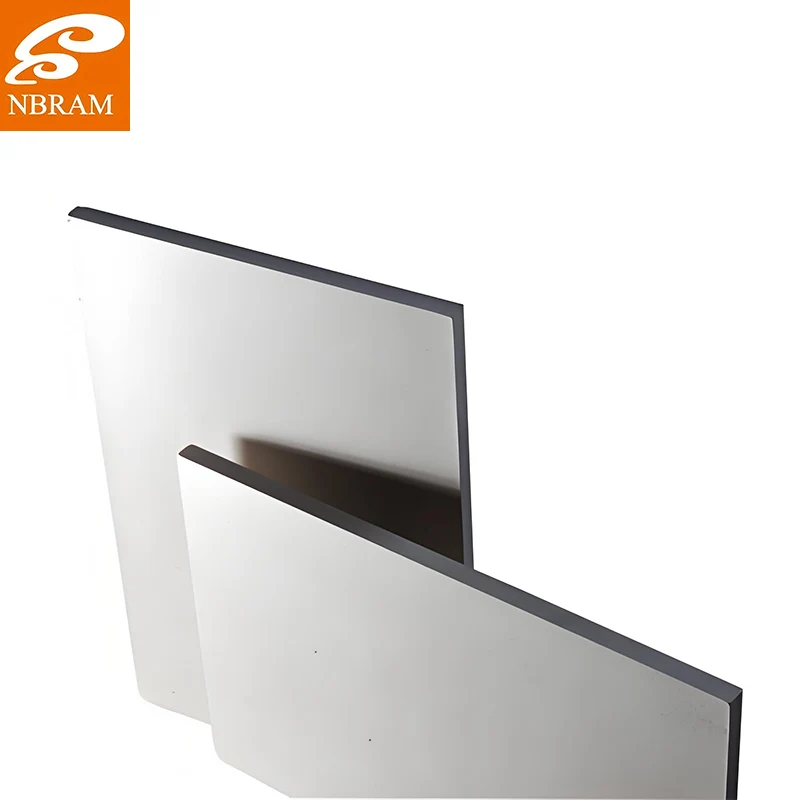
A flexible plate has to do two opposite things. It must conform to the part it insulates, and it must stay dimensionally flat across the sheet. Standard thickness runs from 0.15mm up to 3.0mm, held at ±0.01mm. For a 0.2mm plate the minimum bending radius is 1.5mm, tight enough to wrap small coils by hand with no pre-forming.
Thin and floppy is easy. Thin, floppy and repeatable is not. In our workshop we see the same scene on customer lines: an installer forces a stiff laminate around a radius, the mica layer separates from its backing, and the part fails a hipot test it passed on the bench.
Thermal behaviour rides along with that. Thermal conductivity sits at 0.45-0.55 W/m•K, high enough to spread heat away from a hot spot without shorting one zone into another. Tensile strength runs 40-80MPa depending on thickness, and compression resistance is 100-150MPa, so the plate can be clamped into a stack without thinning out.
Silicone resin does not arrive ready to use. We age it under controlled conditions until it reaches the viscosity that lets it penetrate the mica layers completely, and rheometers track that viscosity in real time through the run.
Miss the window in either direction and you feel it much later. Too thin, and the resin drains out of the stack during cure, leaving dry patches. Too thick, and it sits on the surface instead of soaking in; the plate then delaminates the first time anyone flexes it. This step is unglamorous, and it is the reason batch 40 behaves like batch 1.
With the resin at the right viscosity, the mica goes into a vacuum chamber. Pulling air out from between the layers matters more than it sounds. Every pocket left behind is a place where partial discharge can begin, and at 600°C a pocket becomes a crack path.
Curing is deliberately slow. A fast cure builds cross-linking quickly but locks internal stress into the sheet. Slow curing lets the silicone network form without that stress, which is what keeps the plate flexible after months of service at 600°C instead of days.

Random samples are pulled from every production run and tested destructively for dielectric strength, with a target of 18-22kV/mm maintained after extended exposure to 600°C. Each batch also passes 10,000 flex cycles at both -60°C and 600°C before release. Thickness is verified at ±0.01mm, and standard sheets ship in 1000mm x 500mm or 1200mm x 1000mm, with custom cutting for shapes that are not rectangles.
Documents travel with the material: UL94 V-0 compliance and RoHS (2011/65/EU) declarations. NBRAM has been making mica and thermal management parts in Ningbo since 2004, with ISO9001 across the plant and export customers in Europe and Asia.
If you are specifying insulation for a part that moves, start with the silicone bonded flexible mica plate page, or browse the wider flexible mica sheet range. Send your thickness, sheet size and temperature profile and we will cut samples to your drawing. If your design does not need to flex, the same shelf carries rigid grades under mica sheet.