
When a furnace cycles, the insulation around the heating element takes the worst of it. The metal expands quickly, the ceramic it sits in barely moves, and the mismatch shows up as a crack. Mica tube handles that mismatch differently. Instead of being one solid wall, it is built from layers that are allowed to move against each other.
That single design decision explains most of the numbers on the datasheet, including the ones that look odd at first read.
High temperature resistant mica tube starts as mica sheet, wound around a mandrel under computer-controlled tension so each wrap overlaps the previous one by a set amount. Tension and overlap are the two variables that decide whether the finished wall is dense or full of voids, so the winder holds both instead of letting an operator judge by eye.
The binder is the second choice that matters. Organic resins cure quickly and look fine out of the box, but they have a ceiling; once they burn out, the wall delaminates. Inorganic binders cost more at the winding stage and hold their mechanical and electrical properties at temperatures where a resin-bonded tube would already be losing them.
Mineral grade sets the upper limit. Muscovite mica covers lower temperature work, while phlogopite is the grade specified where stability up to 1000°C is needed. Both are electrical insulators with a layered crystal structure, and that structure is where the thermal behaviour comes from.
A crystal that cleaves in one direction also expands unevenly in that direction. Inside a wound tube those planes sit roughly parallel to the wall, so a temperature change mostly makes each layer slide against its neighbour instead of pushing outward on the whole wall.
Mica expands at a rate close to that of most metals, so a stainless steel support or a metal-sheathed thermocouple moves with the tube rather than against it. Thermal shock runs both ways as well: the material tolerates fast cycling between liquid nitrogen temperatures and red hot conditions, which is what the -269°C to 1100°C continuous service range means in practice.
Electrically the same structure keeps working. Dielectric strength runs 15 to 25 kV/mm depending on wall thickness, insulation resistance stays above 10^13 Ω, and thermal conductivity sits at 0.4 to 0.6 W/m•K. That conductivity figure is deliberate. It is low enough to insulate and high enough that heat does not pile up in one spot behind the element.
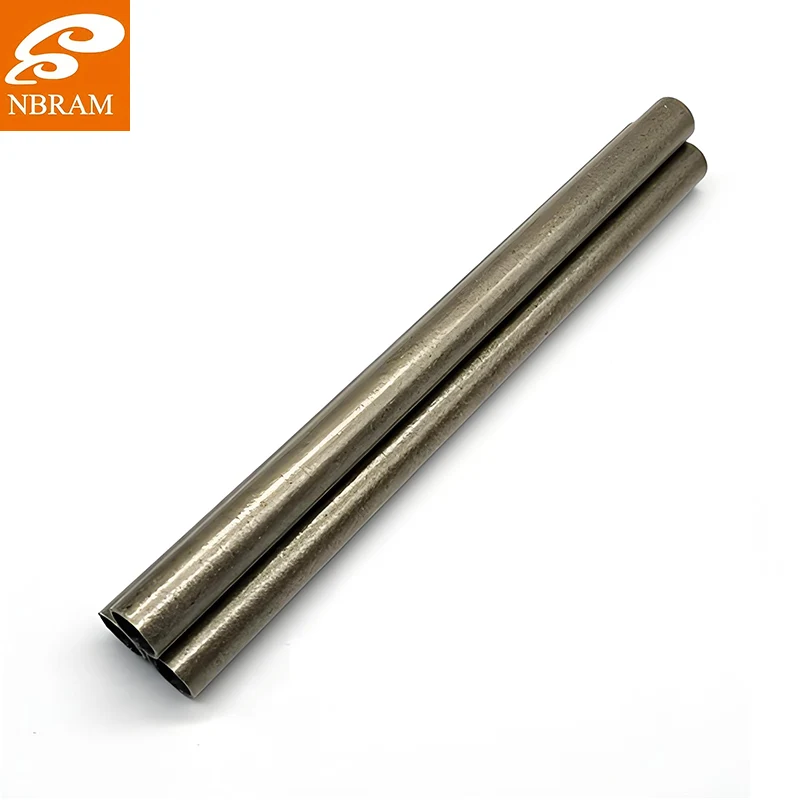
Tubes are produced from 2 mm to 200 mm outside diameter with wall thicknesses from 0.3 mm to 8 mm, which covers everything from a thermocouple sleeve to a furnace support column. Two of those three numbers usually decide the third. A thin wall gives a higher dielectric strength per millimetre but less mechanical support, and a thick wall carries a bending load better while adding mass that takes longer to reach temperature.
Grade selection is where we see the most avoidable failures. Phlogopite is the right call for a furnace hot zone. Muscovite costs less and is often the better answer for a lower temperature assembly where nobody needs the extra headroom. Ask for the working temperature rather than the peak, because the wall is normally rated on continuous service.
Typical duty is industrial heating systems, heating element support tubes, thermocouple protection and furnace construction, plus general electrical insulation in equipment where the surrounding air runs hotter than the components inside. Chemical resistance to most acids, alkalis and solvents matters in the same installations, since furnace atmospheres are rarely clean.
Every tube is checked with ultrasonic testing before packing. It is a slow test, and it is the only practical way to find an internal void or a delamination that would otherwise show up after the first hot cycle.
OEM work here starts with dimensions, quantity and the temperature the part will see. Send a drawing with the outside diameter, wall thickness, length and end finish, and we will quote a wound tube in the grade that suits the duty. The high temperature resistant mica tube page lists the full specification range, the mica insulation assemblies category covers the wider family of wound and punched parts, and tubes that need cutting, drilling or slotting before delivery fall under stamped mica parts.