
A thermostat that opens slowly is a thermostat that opens late. In an oven or a compressor the current keeps flowing while the contacts creep apart, and the arc burning across that last fraction of a millimetre is what eventually welds them shut.
Snap action removes the half-open state entirely. Everything in a snap action thermostat turns on one part, a bimetallic disc that stores its force and releases it in a single movement. Once you know how the disc behaves, the rest of the datasheet reads differently.
Two metal layers with different expansion rates are bonded face to face, then stamped into a shallow dome. Heat makes one layer grow faster than the other, so the dome flattens by a few microns for every degree of rise. Nothing happens at the contacts for most of that travel. Geometry is doing the work, and the disc stays convex until the temperature reaches the point where convex is no longer its stable shape.
Then it inverts. Contacts separate or close within a few milliseconds, with no proportional band, no narrow gap held open and no chatter sitting on the set point. The circuit is either fully made or fully broken.
Differential is set by disc profile and runs from 1°C to 8°C. A tight profile resets quickly for control loops that need it, while a wider one avoids short cycling in compressor protection where the restart itself is the wear item.
Since trip point comes from disc geometry rather than a circuit, holding tolerance is a manufacturing question. Discs are laser-cut to 0.005 mm and vacuum heat treated so the bonded layers keep their shape over the service life instead of drifting after a few thousand cycles. Calibration runs in computer-controlled oil baths that hold 0.1°C stability at the set point, which is where a printed figure turns into an actual trip temperature.
Contacts are silver-cadmium oxide for arc resistance, and contact pressure is set with calibrated torque drivers so the wiping action stays consistent unit to unit. Every thermostat then goes through a 1000-cycle burn-in across its temperature range, a vibration test, an insulation resistance check at 500 VDC and a 1500 VAC dielectric strength test before it is packed.
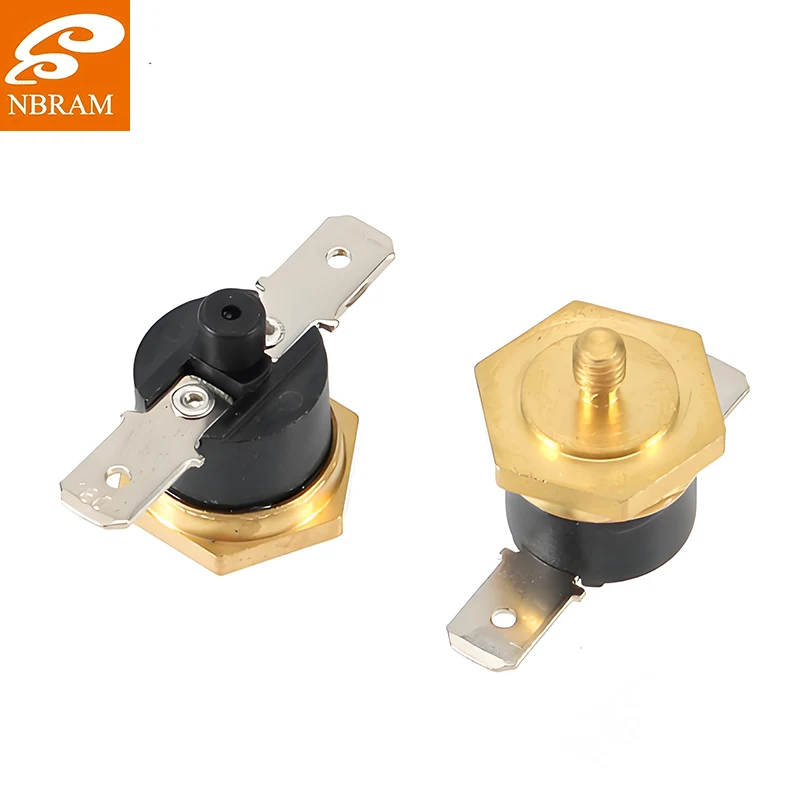
The standard operating range covers -40°C to 300°C. Electrical ratings are deliberately conservative: 16 A models are tested at 20 A continuous, and disc and contact combinations run up to 25 A. Contact resistance stays below 10 mΩ while insulation resistance stays above 100 MΩ at 500 VDC. Mechanical life is rated at 1,000,000 cycles minimum, and units that stay inside their rated temperature typically pass 2,000,000.
Two numbers decide most failures we see in the field. The first is inrush. A cold heating element draws far more current than its running rating, and the disc has to survive that surge every time it closes, not just the steady state printed on the label. The second is ambient. A thermostat mounted inside a hot cabinet at 60°C has already used part of its range before it starts working, so the set point needs to be chosen against the air around the unit, not only the medium it measures.
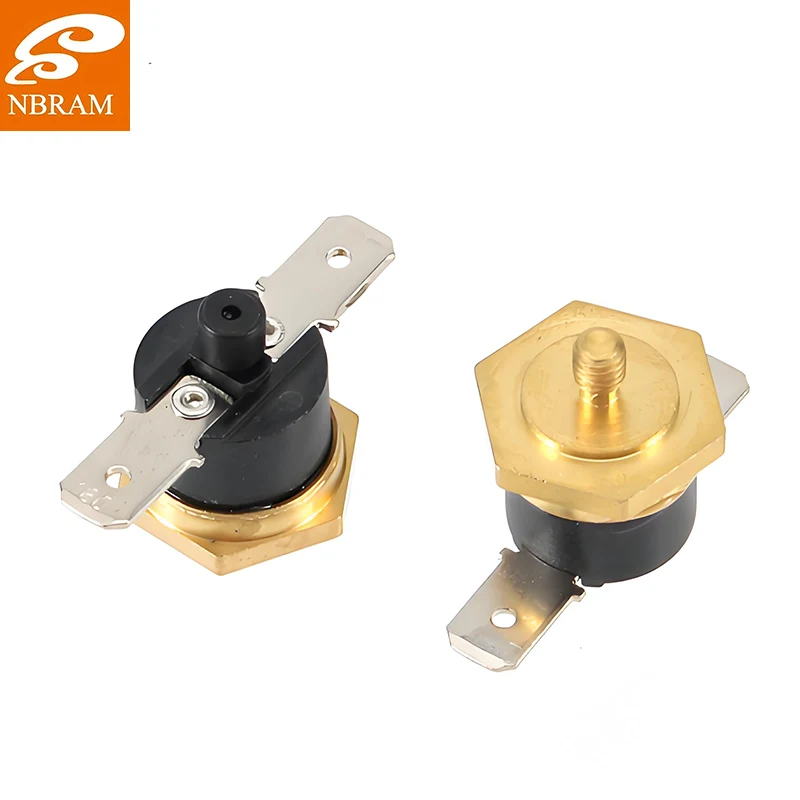
Typical duty covers industrial ovens, refrigeration and compressor protection, medical equipment and commercial coffee brewers holding a brew temperature near 92°C. Automotive and appliance programmes use the same disc technology where a fixed, repeatable trip point matters more than an adjustable one.
OEM versions start with an inquiry: send the working temperature, the load current including inrush, the differential you can live with and the mounting geometry. NBRAM has built mica and ceramic thermal components in Ningbo since 2004 under ISO 9001, with materials compliant to RoHS (2011/65/EU), and the same engineering team works on thermostats and the heating elements they protect. The snap action thermostat product page lists the full specification range, the bimetal thermostat category covers the wider family, and adjustable set points sit in the KSD 9700 series.