
A coil of resistance wire looks the same whether it will last five years or five months. Same surface, same reading on the caliper. The difference turns up later, in an element that drifts off setpoint after a few hundred cycles, or one that sags until it touches the sheath.
We have drawn alloy wire in Ningbo since 2004. Most arguments we get into about "bad wire" are really arguments about tolerance, and tolerance is settled in three places before the wire ever reaches a winding machine.
Two heats of the same NiCr 80/20 grade can still land at different points inside the 0.8 to 1.4 µΩ·m resistivity band. Trace elements, not the headline nickel and chromium percentages, are what move the number.
That is why our heats are vacuum melted with trace elements held to within 0.01%. At 800°C to 1200°C continuous duty, and up to 1400°C on premium grades, oxidation is a diffusion process. Whatever is chemically loose in the alloy moves first. A clean heat ages slowly; a dirty one does not.
Rod becomes wire through a chain of passes, from 2.0 mm at the coarse end down to 0.05 mm. Each pass work hardens the alloy. Skip the anneal between draws and you get wire that measures correctly on the spool, then cracks on the customer's winder.
Diamond dies hold diameter within ±1%, and the anneals keep elongation at break in the 15% to 25% range. That elongation figure is worth asking about. It is what lets a coil be wound tight around a small radius without surface cracks that only open later, under heat.
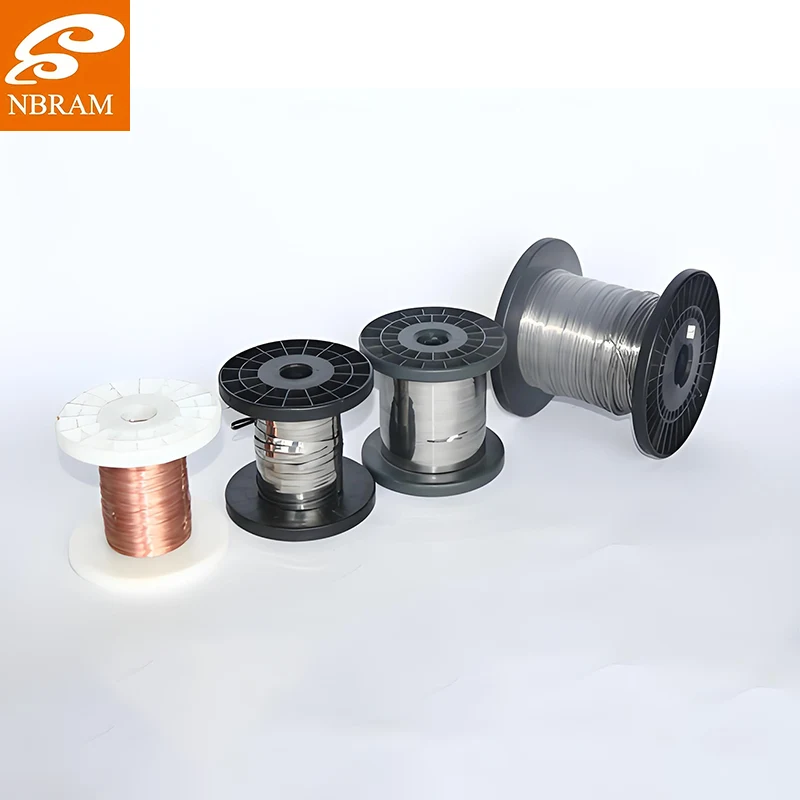
Resistance is measured at several points along each spool, not once at the start. Drift along a single length is the defect that hurts most, because it passes a spot check and then produces elements that run hot at one end.
Spooling is tension controlled so the wire is not stretched on its way to the reel, and every spool ships vacuum sealed with desiccant. We have opened enough incoming samples from other suppliers, furred white with oxide before they were ever energised, to keep that step in the process.
High temperature cycling on sample coils is the last gate. It is a short test against a long service life, though it does catch the heats that looked fine on paper.
Both alloys are in our range, and the choice is usually about duty cycle rather than price. Nickel-chromium brings oxidation resistance and mechanical strength that suit intermittent operation and elements switched on and off all day. Iron-chromium-aluminum goes higher for continuous industrial heating, with the caveat that it is more brittle once it has been hot.
Unsure which one your drawing wants? Send the element drawing and the working temperature. We will say which alloy we would draw it in, and which tolerance the application actually needs.
Our resistance wire page lists the full diameter and resistivity range, and the PTC heater category covers the assembled elements we build from it. Sample coils for winding trials and OEM spool sizes are quoted on request.