
A roll of silicone resin bonded mica tape can look perfect coming off the slitter and still fail on a customer's winding line six months later. The edges whiten. Resin dust appears on the glass cloth. A fold along a rectangular coil corner opens into a hairline crack. In most of the complaints we look at, the mica is not the culprit. The binder is.
That split of duties is worth understanding before you specify the tape. The mica flake does the electrical work. The silicone resin holds the flake stack together and decides whether the tape can be wrapped tight around a corner without splitting.
Mica is split into thin, overlapping flakes and laid down as a continuous barrier. That barrier is what sits between a conductor and ground. On this tape the mica layer runs 0.08mm to 0.15mm thick, and the published dielectric strength is 6-8 kV/mm. The datasheet temperature range reads -50°C to 1000°C, and it is the mica, not the polymer, that earns the top of that window.
The silicone resin has a less glamorous job, and a harder one. It has to wet every flake, bond the layers, and still bend when the tape bends. Cure it too hard and the roll behaves like a thin sheet of glass: fine on a straight run, brittle the moment an operator pulls it around a coil nose. Our resin is formulated to stay supple after cure, so a wrapped coil does not shed flakes when it is handled, stacked, and pressed before varnish.
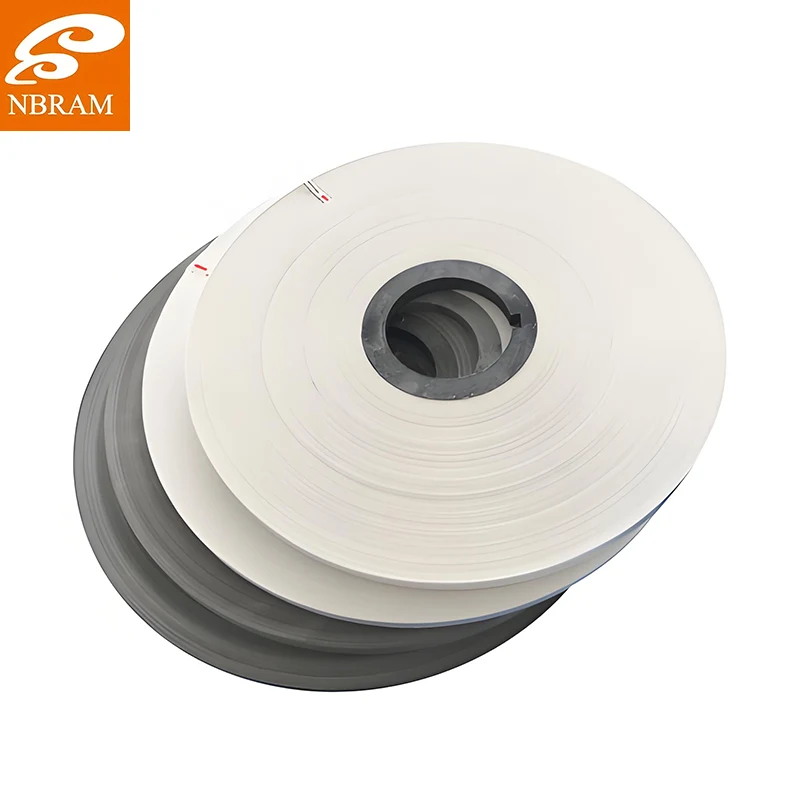
Saturation happens on a knife-over-roll line, with the mica-resin blend driven into a glass fiber mesh or a polyester film carrier. The setting we watch is not the average coat weight. It is the spread.
A resin-rich patch makes the tape stiff and tacky, and it can block on the winder. A starved patch is worse. Dry flake with no binder around it is a void in the insulation wall, and a void is where partial discharge starts once the coil is energised. Keeping the knife gap and web tension steady through a long run is the whole game. Every inch has to leave the line with the same resin-to-mica ratio as the first inch.
Resin that skins over before the volatiles escape traps them underneath. You get bubbles, blisters, or a puckered surface that will not lie flat on a winding. So the ovens ramp temperature in stages rather than jumping to set point. Heat comes up gradually, the resin gels evenly through its thickness, and the tape leaves the oven flat with no distortion across the width.
There is a trade-off here that customers rarely see. A faster ramp raises output. It also raises the reject rate at the flex test, which is why we keep the ramp conservative and accept the slower line speed.
Slitting follows curing, from 10mm up to 1000mm wide, then winding with edge protection so the roll does not arrive with crushed edges that fray on the first wrap. Specifying a non-standard width or a different adhesion level is routine for us; the slitter and the resin batch are set per order.
Testing is where a tape either earns its label or does not. Each batch is checked for dielectric strength, flexed repeatedly to imitate the stress of installation, and cycled between temperature extremes to compress years of service into days. Compliance runs to IEC 60371 and ASTM D352. We also confirm compatibility with common industrial varnishes, because most taped coils are impregnated after wrapping and a binder that reacts badly to varnish undoes the work done at the winding station.
If you are choosing insulation for motor windings, transformer coils, or fire resistant cable builds and want to compare a sample against your current tape, send us the thickness, width, and service temperature you are working to. We will cut a roll to match. Details are on the Silicone Resin Bonded Mica Tape page, and the wider range sits under Composite Mica Tape and Motor Insulation Mica Tape.