
Most electrical fires inside a plant do not start with a naked flame. They start with a loose terminal, a crushed cable sheath, or a fault arc that dumps a few thousand degrees into a handful of square centimetres of insulation. What happens in the next thirty seconds decides whether the event stays inside one cabinet or runs the length of a cable tray.
Flame retardant mica tape is one of the materials that decides it. Not because it is fireproof in some absolute sense, but because of what it turns into once the heat arrives.
Mica is a layered silicate. Split it thin enough and you get a paper that does not melt, does not drip, and keeps its shape long after organic films have boiled off. That mineral skeleton is the reason mica tape appears in fire resistant cable designs at all.
The flame retardant part is chemistry added during impregnation. A controlled saturation step pushes the compound through the full thickness of the paper instead of laying it on the surface, so a tape that gets scuffed during winding still behaves the same way at the scuff. Coated products lose their rating the moment the coating is damaged, and that is exactly what happens when a fitter pulls a wrap tight around a bend.
One number summarises the result: limiting oxygen index above 35%. Ambient air is about 21% oxygen. A material at LOI 35 needs a far richer oxygen atmosphere than that to keep burning, which is why the tape stops feeding its own combustion as soon as the ignition source is taken away.
Our flame retardant mica tape runs from 0.13 mm to 0.25 mm in thickness. Go below that band and the dielectric margin gets thin for 800°C service. Go above it and the tape stops conforming to tight radii, bridging at the corners instead.
Flame spread index to ASTM E84 comes in under 5. In a vertical tray test that is the difference between a flame that climbs and a flame that stalls. Dielectric strength holds 35-40 kV/mm even at 800°C, and volume resistivity stays above 1.5×10¹⁵ Ω•cm through a thermal runaway event. Tensile strength of 160-200 N/10 mm width is what keeps a wrap intact while the cable is dragged through a duct.
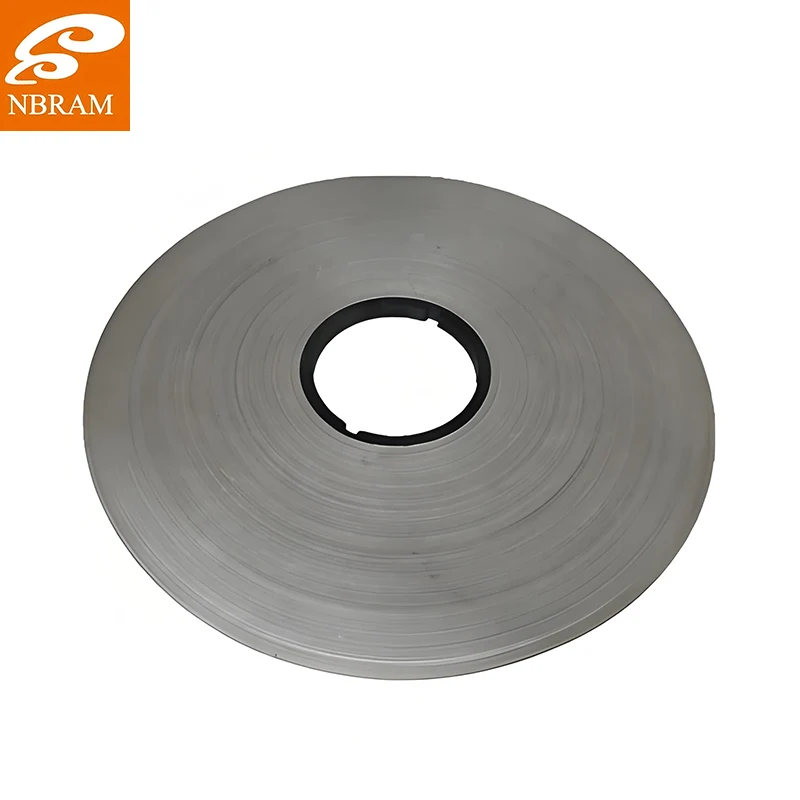
Drive the tape past the point where the binder burns off and the mica re-sinters into a ceramic layer. That layer is weaker than the original tape, yet it still insulates, and it still separates conductor from earth. Circuit integrity tests are interested in that window, not in whether the wrap looks untouched afterwards.
The failure mode worth watching is char that crumbles. If the residue turns to powder when you touch it, the wrap has lost its structural job and the conductor is one vibration away from a short. Mineral-filled systems leave a coherent residue because the mica fraction does not volatilise.
Bonding choice matters more than most buyers expect. Silicone-bonded grades stay flexible and suit hand-wrapped harnesses, formed parts and repair work. Epoxy-bonded grades are stiffer, wind better on automated equipment, and hold dimension under clamping pressure. Both are available with the flame retardant treatment. The difference shows up on the production line, rarely on the datasheet.
Tell us your operating temperature, conductor size and required wrap thickness. We produce flame retardant mica tape in roll and slit form at our Ningbo plant, and we quote against your drawing rather than a catalogue number. Start from the Flame Retardant Mica Tape page, or browse the Composite Mica Tape range for bonded constructions.