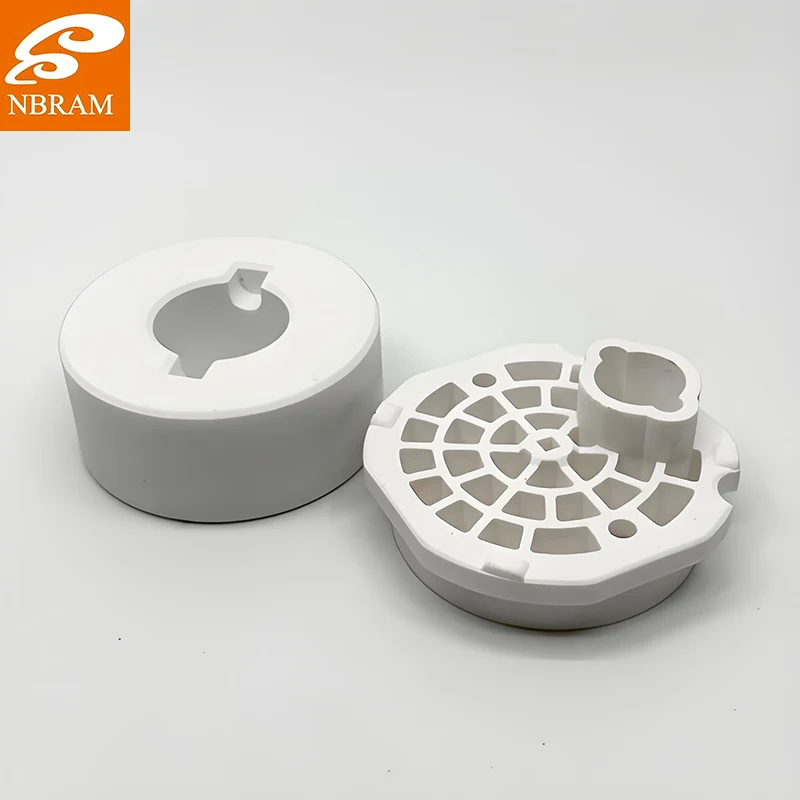

Ask a maintenance crew why a pump seal failed, and the answer is usually the O-ring, the spring, or the flush plan. Look at the faces afterwards and the story changes. Two flat discs, one turning with the shaft and one standing still, carry a film of process fluid a few microns thick, and everything a seal promises depends on how faithfully those surfaces stay parallel.
We grind alumina rings for exactly that job in our Ningbo plant, and most seal problems that reach us trace back to three numbers on the drawing: flatness, roughness, and how far the ceramic moves once the pump is hot.
Seal faces get checked on an optical flat. The fringe pattern tells the grinder whether a surface is truly flat or slightly domed, and one light band equals roughly 0.3 µm of departure. Alumina rings leave our line at one band.
The reason is easy to miss. The fluid film is thinner than that. Domed by two bands, a face touches its mate at the outer edge only, so the gap opens toward the bore, pressure pushes fluid through, and the outside runs hot and dry. Roughness matters just as much at the contact. We polish to Ra of 0.1 µm or better, because a coarser face behaves like a lap and grinds the carbon mating ring instead of riding on the film.
Alumina at 85 to 90 HRA is harder than most of the metals it will ever meet. That hardness is what lets a ceramic ring work against carbon, silicon carbide, or hardened metal without losing its shape in the first weeks of service. In slurries, and in wastewater where grit gets past the strainer, it is the line between a ring that holds its geometry and one that quietly polishes itself away.
Squareness gets less attention than it deserves. We hold perpendicularity within 0.001 mm so the face sits true to the shaft axis. A tilt of two or three microns shifts the load onto one side of the ring. That edge wears first, the gap becomes a wedge, and the seal weeps where it was tightest when new.
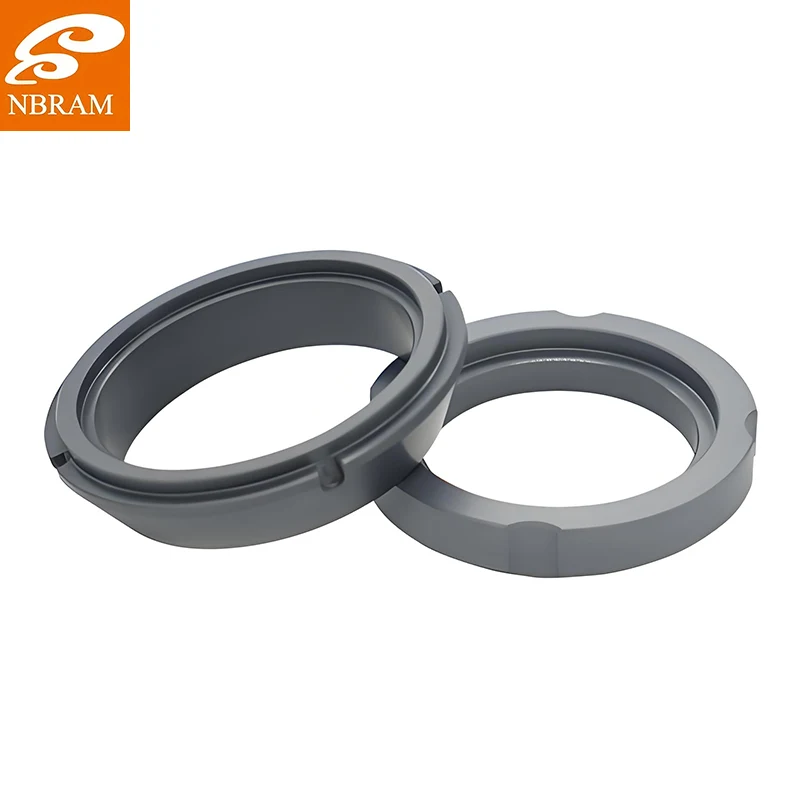
Heat is where face flatness works against itself. A ring on a shaft sleeve and a ring clamped in a gland do not warm at the same rate, and if the two grow differently, the gap that measured one light band cold turns into a taper once the pump reaches temperature. We match the expansion of the alumina grade to the mating material named on the drawing, carbon or silicon carbide in most cases, rather than quoting one figure for every pump.
Density below the surface decides whether a ring stays flat through a long campaign. We start from 99.6% alumina and press isostatically at 200 MPa, which gives uniform density through the wall instead of the gradients that later show up as warp. Sintering is held at 1650 °C on a controlled profile, so the crystal structure comes out hard without turning brittle at the edge.
Rings run from 10 mm to 250 mm outside diameter, with custom geometry for specific pump designs. Each piece is measured dimensionally and inspected on the face; samples from every batch go through destructive testing to confirm what the outside surface only hints at.
If a pump in your plant is eating seal faces, send the drawing and the duty point. We quote sample rings in the grade that matches the counterface you already run. Start from the ceramic seal ring for pump mechanical seals page, or look through the wider wear resistant ceramics range for liners, plates and bearings that take the same abrasion.